


Program Description
A Bachelor of Science in Education - Secondary Mathematics is designed to produce graduates who are qualified to pursue careers as math teachers in grades 5-12 in the Turtle Mountain area or across North Dakota and the United States.
Candidates who complete the program will have passed all three Praxis examinations and completed student teaching to become a highly-qualified licensed math teacher. The program is accredited by the Higher Learning Commission and the North Dakota Department of Public Instruction. The program will produce teachers who are fully equipped to engage students with Indigenous ways of teaching and learning as well as Indigenous math, all balanced with the Western perspective to advance the opportunities for all students.
Candidates entering the 4-year program should declare for a B.S. in Secondary Math Education degree in their freshman year. Candidates will take approximately two math courses each semester beginning their freshman year and two education courses each semester beginning their sophomore year. A cohort structure begins their junior year with each cohort capped at 15 students. Cohorts start every two years. The program is designed to ensure candidates take the required courses in 8 semesters.
Mission
Before colonization and assimilation, Indigenous communities had a mathematics system, but today various communities have limited knowledge about Indigenous math. The mission of the Secondary Mathematics Education Bachelor of Science degree program at Turtle Mountain College is to prepare future middle school and high school math teachers with content and pedagogical knowledge from a balanced perspective of Western and Indigenous ways of knowing – two-eyed seeing. “We have come to understand that Western mathematics and Indigenous mathematizing can be viewed as having complementary strengths. Recognizing the strengths of each will maximize mathematical learning for all students” (Sterenberg & O’Conner, 2018, p.185, cited in Meyer & Aikenhead, 2021, p.129-130). Strong K-16 math education is essential for economic and political self-determination and self-sufficiency of Native nations.
Application Deadline
Review the TMC Academic Calendar for admissions & registration deadlines for each semester.
Program Learning Outcomes
Students who successfully complete the program will be proficient in six Program Learning Outcomes. Each of the six Program Learning Outcomes (PLOs) has a one-sentence description, an assessment plan, and the list of the core courses designed/assigned for students to reach proficiency in that PLO.
Career Outlook
Western Math PLO:
• Students will demonstrate proficiency in North Dakota required content standards.
• Assessment – Praxis II results, ND ESPB Standards 11010.1-5
• Core Courses – MATH 165, MATH 166, MATH 366, MATH 380, MATH 480
Indigenous Math PLO:
• Students will articulate Indigenous mathematical ways that are place-based and language-specific.
• Assessment – Community presentations
• Core Courses – MATH 172, MATH 272, MATH 372
Two-Eyed Balanced Math PLO:
• Students will articulate the connections between Indigenous Math and the North Dakota Secondary Math Content Standards.
• Assessment – Math modeling project
• Core Courses – MATH 341, MATH 342, MATH 364
Western Education PLO:
• Teacher candidates will demonstrate proficiency in the North Dakota required pedagogical standards.
• Assessment – Praxis II results, ND ESPB Standards 11010.6-7, InTASC Assessments 1-10
• Core Courses – EDUC 299, EDUC 329, EDUC 353, EDUC 472
Indigenous Ways of Teaching and Learning PLO:
• Teacher candidates will implement Anishinaabe ways of teaching, learning, and knowing (e.g. decolonizing, community, and place-based education).
• Assessment – Community presentations
• Core Courses – EDUC 320, MATH 172, MATH 272, MATH 372
Two-Eyed Balanced Education PLO:
• Teacher candidates will implement pedagogical practices at the overlap between Western education and Indigenous ways of teaching, learning, and being (e.g. collaborative, student-centered, equitable, and caring pedagogical practices).
• Assessment – EDUC 472 Unit Plan
• Core Courses – EDUC 472, EDUC 414/415
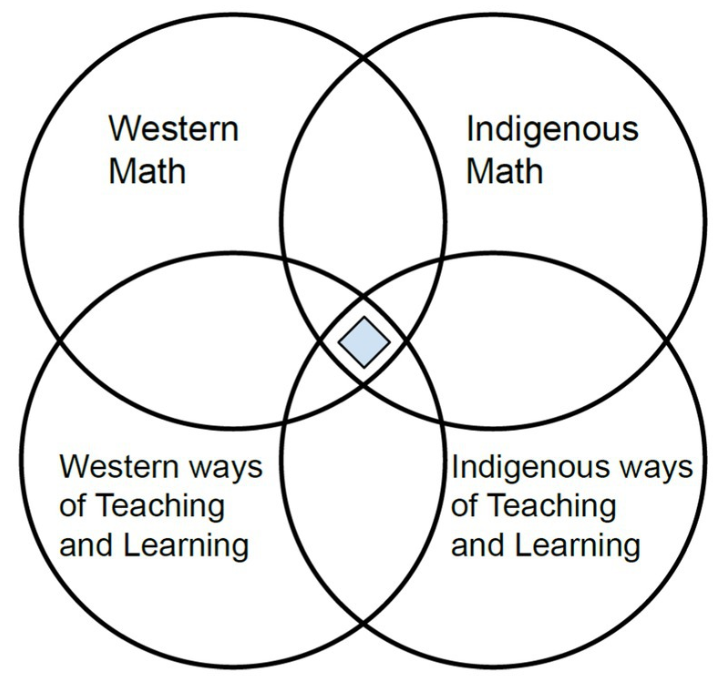
The six PLOs are in alignment with the Indigenous Math Education Framework (see below). Each of the four circles are distinct and can stand on their own. Further, each circle is self-justifying, meaning that it does not need justification nor validation from another circle. Specifically, Indigenous Math does not need to be validated or verified by Western Math to be considered legitimate. Third, each circle is equivalent in size showing equivalent value. This is the desired and ideal scenario that the program continues to pursue. Lastly, the four circles are all interconnected. Despite the little black lines showing rigid boundaries between the intersection and exclusion areas, these four topics are interconnected, interdependent, and always shifting in relationship with each other.
Indigenous Math Education Framework
Credit Hours
Credit Requirement Breakdown
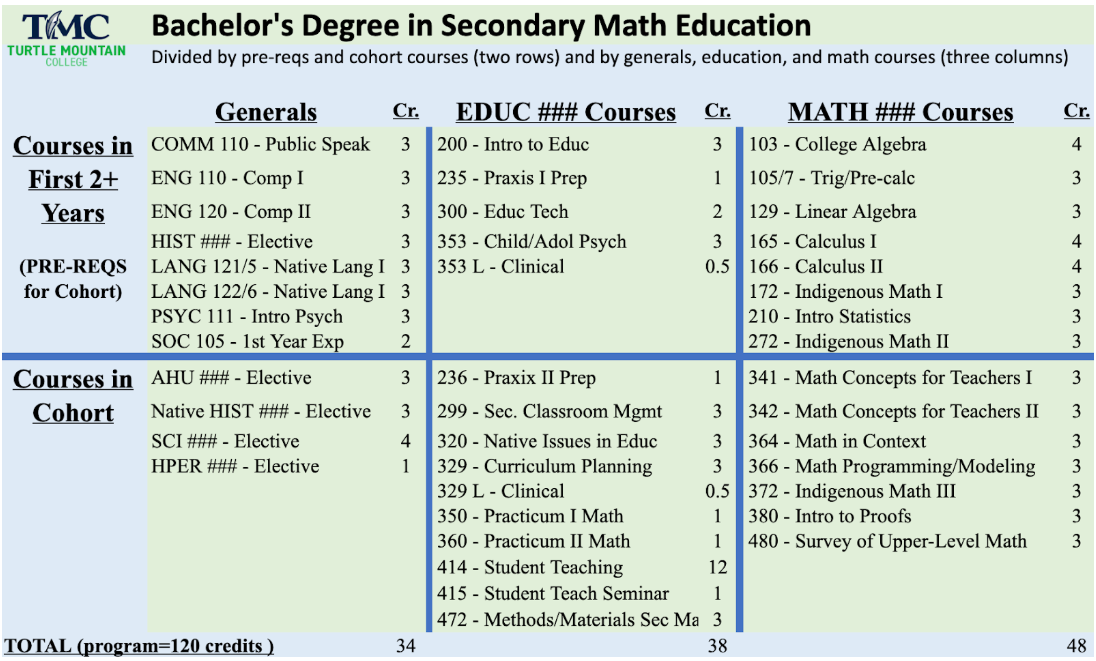
Total Credits for the 4-year Program: 120
Total Credits for the General/Core: 34
Total Credits for the EDUC portion: 38
Total Credits for the MATH portion: 48
Requirements
Program Degree Graduation Requirements:
Cumulative GPA of at least 2.75
Teaching Specialty (Math Prefix Courses) GPA of at least 2.75
Pass All Courses
Pass Praxis I, Praxis II PLT, and Praxis II Secondary Math Exam
Admission Requirements to TED – Math Education Cohort:
Admitted to TMC
Completed pre-requisite courses (up to 9 credits can be yet to complete without special/conditional acceptance)
Plan of Study Grid
Overview of entire program:
Suggested Annual Schedule
Year One (Fall)
-
Course ID
Course Title
Credits
-
COMM 110
Fundamentals of Public Speaking
3
-
ENGL 110
College Composition I
3
-
HIST # #
History Elective
3
-
MATH 103
College Algebra
4
-
SOCI 105
First Year Experience
2
-
Total Credit Hours:
15
Year One (Spring)
-
Course ID
Course Title
Credits
-
ENGL 120
College Composition II
3
-
MATH 105 or MATH 107
Trigonometry or Pre-Calculus
3 or 4
-
MATH 129
Basic Linear Algebra
2
-
MATH 210
Elementary Statistics
3
-
PSYC 111
Introduction to Psychology
3
-
Total Credit Hours:
14
Year Two (Fall)
-
Course ID
Course Title
Credits
-
EDUC 200
Introduction to Teaching
3
-
EDUC 300
Educational Technology
2
-
LANG 121/125
Native Language I
3
-
MATH 165
Calculus I
4
-
MATH 172
Indigenous Math I
3
-
Total Credit Hours:
15
Year Two (Spring)
-
Course ID
Course Title
Credits
-
EDUC 235
Preparation for Praxis I
1
-
EDUC 353
Child & Adolescent Psychology
3
-
EDUC 353L
Clinical I
0.5
-
HPER # # #
Health and Physical Education Elective
1
-
LANG 122/126
Native Language II
3
-
MATH 166
Calculus II
4
-
MATH 272
Ojibwe Math II
3
-
Total Credit Hours:
15.5
Year Three (Fall)
-
Course ID
Course Title
Credits
-
EDUC 236
Praxis II-Secondary Science
1
-
EDUC 329
Curriculum Planning & Evaluation
3
-
EDUC 329L
Clinical IV
0.5
-
HUMM
Arts/Humanities Elective
3
-
MATH 341
Math Concepts for Teachers I
3
-
MATH 372
Ojibwe Math III
3
-
MATH 380
Introduction to Proofs
3
-
Total Credit Hours:
16.5
Year Three (Spring)
-
Course ID
Course Title
Credits
-
HIST
Native American History Elective
3
-
EDUC 299
Secondary Classroom Management
3
-
EDUC 320
Native Issues in Education
3
-
EDUC 350
Practicum One
1
-
MATH 342
Math Concepts for Teacher II
3
-
MATH 480
Survey of Upper-Level Math
3
-
Total Credit Hours:
16
Year Four (Fall)
-
Course ID
Course Title
Credits
-
Science & Lab Elective
Science and Lab Elective (4)
4
-
EDUC 360
Practicum II
1
-
EDUC 472
Methods and Materials of Secondary Math
3
-
MATH 364
Math In Context
3
-
MATH 366
Mathematical Programming and Modeling
3
-
Total Credit Hours
14
Year Four (Spring)
-
Course ID
Course Title
Credits
-
EDUC 414
Student Teaching
12
-
EDUC 415
Student Teaching Seminar
1
-
Total Credit Hours:
13